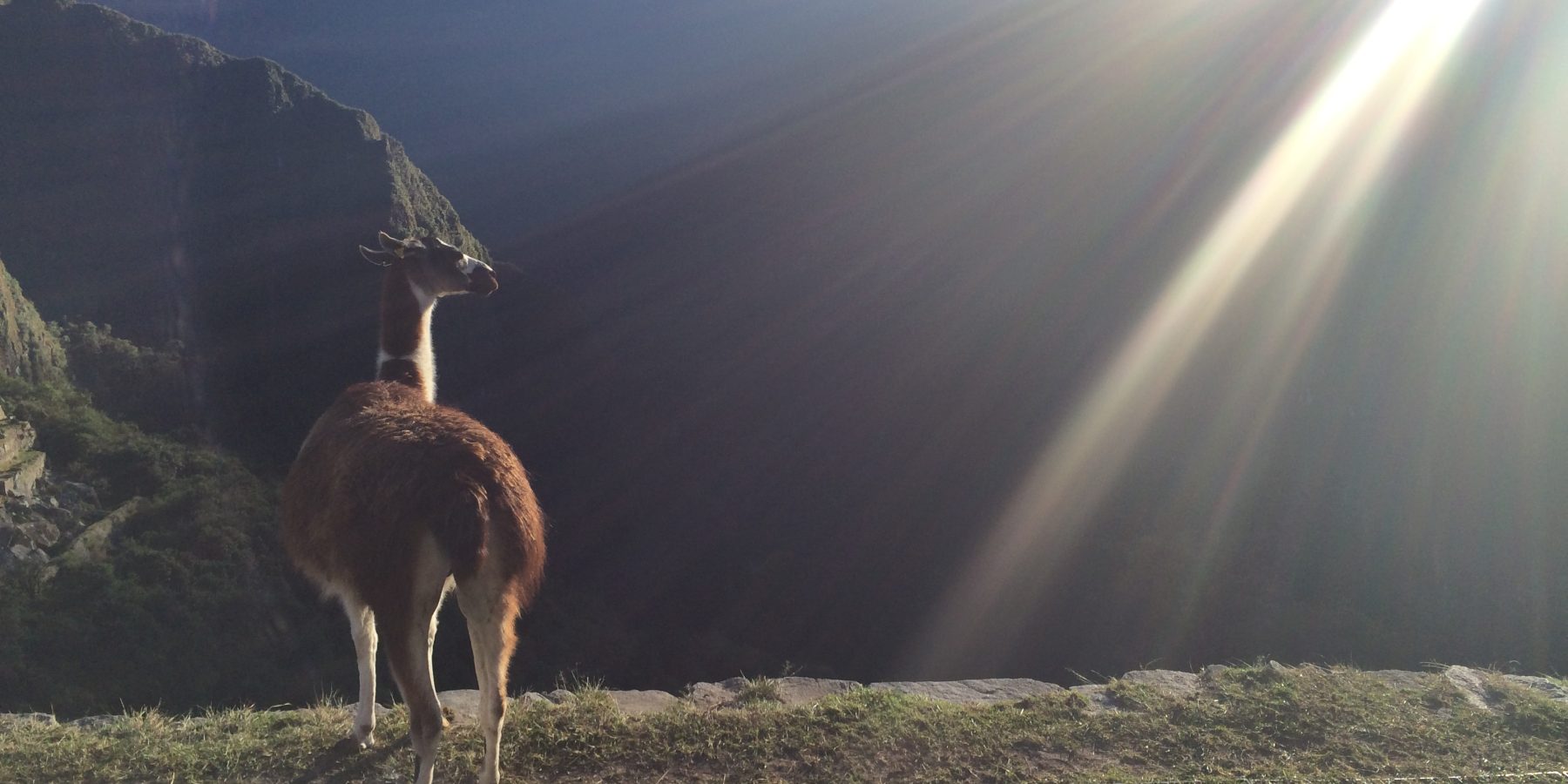
In 1532, a Spaniard arrived in Peru, and saw a curious animal that liked to spit and looked a bit like a big shaggy goat. He asked a local Incan: “Cómo se llama?” (What is it called?)
The Incan did not understand the question, and echoed back, with a raised eyebrow: “¿Llama?”
…and that is how the llama got the name that we now know and love. Its original pre-llama name was lost in the Andean mists of time.
Speaking of The Andes, in Quechua language their name means “mountain light”. As the sun rose over the mountains at dawn, light would be streaming over them, and the Incan sun-worshippers would feel closer to their gods. To be in divine proximity, the Incans also liked to build their shrines and temples up high. This is also where they would make their sacrifices so they could be expedited to the gods.

I am discovering all of this as my journey through Peru leads to the city of Cuzco, which is over 1000 years old, up into the mountains through pre-Incan and Incan sites, and all the way to Machu Picchu. I have actually been feeling rather confused, trying to get “facts” straight — and that is no easy proposition here. And it is not just the high altitude with its lack of oxygen which is to blame!
Here is my potted understanding of the history that may explain the confusion:
Before the Incans came along, there were a number of other smaller civilisations and tribes in Peru, Bolivia and the neighbouring countries. One could give these the umbrella term of “pre-Incans”. The Incans rose to power through assimilating these other cultures (a bit like the Borg in Star Trek, for the Trekkies out there!), learning construction, engineering, masonry, hydraulics, martial fighting technique, and even religious rites from these other cultures. This assimilation of cultures gave rise to the rainbow-coloured Incan flag, called the wiphala.
The Spaniards then arrived, as per the llama story above, and the Incans wondered whether these new people were gods, with their taller stature and fairer skin. It became clear that the Spaniards did not have particularly benevolent intentions though, as they killed the Incan emperor and started to pursue his brother too, and ended up in a full-scale Incan massacre.
This was all the opposite of the more peaceful assimilation principle of the Incans.
The Spanish massacre extended to the Incan culture, too: sacred Incan sites were plundered for precious metals, and exquisitely carved rocks were repurposed to build Catholic churches. As the Incans fully understood the Spaniards’ destructive intentions, they started to abandon, change, and conceal their sites so their secrets would not be given away… This included the site of Machu Picchu, which the Spaniards never found, and thus never destroyed.
The catch was that the Incans did not have a written language, so many of the techniques they used, for example to carve and transport massive slabs of rock, or to direct underground water springs to the surface, were lost. This has left us, today, with a lot of speculation about much of their culture. The chronicles of the Spaniards, on whose written language we have to rely for this episode of history, are apparently highly romanticised and rather in-credible in places.
To bring this tale of misunderstanding, speculation and confusion back to the realms of the tangible, perhaps we should talk about the bones and the stones.
I laid eyes on the skeletons of 12 long-dead Incan stonemasons in a mountainside grave that faced Mount Veronica above Ollantaytambo. Grave robbers got there before the archaeologists, so only bones remained. The skeletons were likely of workers from the granite stone quarry that the mass grave was right next to. The cave felt cold and dark even as I crouched in its opening under the late morning sun. Secrets were buried here.

Outside the cave lay plinths of granite several metres long, and no doubt several tonnes in weight, that had been carved and awaited transport down to Ollantaytambo. All of this had been abandoned as the Spaniards approached.
Skidding and slipping down the dusty path of rubble towards the valley, I saw other granite slabs that had been similarly left. Before they left this place, did the Incans push these carved slabs down on special rounded stones, like huge marbles? Or did they pull them on blankets of smooth Andean grass? Was there a system of levers? Were aliens involved, even? It is easy to fall back into speculation with these huge and fascinating artefacts… and three guides on our tour had three different favourite explanations for how the stones were carved and transported.
As I walked the breath-taking grounds of Machu Picchu today, I felt surprisingly peaceful with the not-knowing. I was told that 70% of Machu Picchu is in its original shape and layout, while 30% has been reconstructed with the imagination, and perhaps whims, of 20th century archaeologists. Even with the crowds of tourists there, I knew that 100% of my experience was down to my own senses, imagination and openness to the offering of my surroundings. And that offering was generous as the first beams of sun cracked over the mountain ridges, just days after the winter solstice, and bathed the site in bright light.
I did not need to be an Incan to feel Apu, the spirit of the mountains, close to me. As I journeyed deeper into the maze of Machu Picchu, I felt deep peace and reverence while I rested in a three-sided building in the area dedicated to shrines. This was open to the god of the Wind on the front facing the sun. Next to this shrine was a temple to the Fire god; below was a shrine to Pachamama – Mother Earth; and diagonally in front was a beautifully carved stone-lined fountain to host the Water god.

This balance of elements felt sublime in my being. I did not need to understand anything else at that moment. Llamas, brought down from their naturally higher habitat to delight tourists, grazed nearby and seemed just as content to keep things simple – no matter their name.
Much later, as we returned to Cusco, I noticed once again the rainbow-striped flags that the Incan Territories of the 21st century proudly fly in Peru and Ecuador. Anyone who did not know about the wiphala flag origins and meaning would think that they had just entered the most gay-friendly city in the world… More confusion, misunderstanding and layers of added meaning through history.
As my journey now heads up into the Altiplano, to meet the native tribes there, perhaps things will become as simple as in the shrines of Machu Picchu once again.


