“There’s a big one coming…” says Luis, our tour guide. Chile and Mexico have both had substantial earthquakes in recent years, and Peru is now overdue another quake – of substantial proportion.
I take in the bright yellow footbridges that lead up from the flat beaches, over the road, and up to the high ridges behind, as we drive down the coastal highway from Lima’s airport to the district of Miraflores. These footbridges are part of the natural disaster management strategies in Peru, to allow those on the beaches to evacuate to high ground quickly in case of an incoming tsunami. We are in the midsts of sporadic tectonic fury, here on the Pacific Ridge.
This is not something on a TV screen far away, but a daily reality for Peruvians. I pat myself down emotionally to check for any fear moving in me, with my lifetime of living in more seismologically boring places, and I notice it is more like a potential of fear, still removed from me, lurking somewhere in the depths of the earth here, bubbling away and awaiting its moment of inevitable release…

Luis then points out a fine fish food restaurant on a long finger of land that extends bravely into the Pacific Ocean. The “Rosa Nautica” – the nautical rose. I half-ask half-state that when a tsunami comes in, that restaurant will be gone… and Luis does not miss a beat in responding: “Well, then they will be serving VERY fresh seafood!”
The potential of fear in me turns to laughter. I know this brand of black humour well, and it can make life tick on cheerfully on the brink of death — or at the edge of a tectonic plate!
The historical buildings we stroll through in downtown Lima, hours later, have conspicuous signs hanging in arches and other structurally solid places within them: “Safe zone in case of earthquake” they loosely translate. So gather here when the earth starts to tremble… and the safest place of all, with a splendid twist of irony, is in the catacombs under the Franciscan monastery. As I duck my head through the low arches down there, I do not see a single crack in the walls that were built in the 16th century A.D. and have withstood a multitude of earthquakes since then. The domed underground structures down here, built with mixture of rocks, pebble, mud and seagull egg whites (according to the dramatic guide, who looks like she has delivered the swan song of an opera with every line of information given), have a remarkable capacity to withstand seismological tremors. That’s nice for all the stacks of femurs, tibias, humeruses and skulls that are arranged neatly in herringbone and mandala patterns down here… Remnants of the hundreds of thousands who were deposited in this sacred ground under the monastery, from the time of the Inquisition and onwards.
Above ground again, we are treated to another historical wonder: an enormous mural from the 17th century depicting The Last Supper with Jesus and His Disciples. There is Judas, easily recognisable with a semi-transparent devil behind him, blowing an ill wind down his neck… Potatoes adorn the table, treating this holy band to a staple of the local diet: “papa”, as they call them in Quechua, the language of the Andes here. And splendidly, right in the middle of the table in front of Jesus, the most holy guest, is an offering fit for a king of Heaven: a roasted guinea pig!
I cannot help myself from stepping up close to the mural to examine the truth of this statement from the guide, who has thankfully not expired yet despite the repeated swan songs. If she had not explained what it was, I have to admit I might not have known – I am no roast guinea pig specialist… yet! Luis says it is a must-try in Cuzco where we are heading soon. I will confirm its similitude to what Jesus was eating at that time.
The rest of the monastery and its courtyard garden is truly beautiful, and I feel the gentle appeal of a life spent in quiet contemplation, reading books, partaking in ceremony, and tending to the Soul. There is a library with winding wooden spiral staircases, books and tomes that are many centuries old in a wide array of languages, and dark wooden tables for lectors. The architecture has numerous windows and skylights to allow for reading from dawn to dusk. I could spend years there.
Outside again, it almost feels sunny now, in this city that has permanent cloud cover for 9 months of the year. When we were coming down to land at Lima airport, we came through a layer of clouds and saw the peaks of the Andes: rugged and wild-looking in the dawn light. Then there was another layer of cloud covering the lowlands at their feet: a double cloud sandwich. All of this has the effect of making Lima appear somewhat like a greyscale, desaturated landscape, where the sun is strongly filtered and the humidity is high. But now, the sun is almost shining through and the sensation of warmth on my skin is delectable… My jetlag feels like it is evaporating into the warm afternoon.
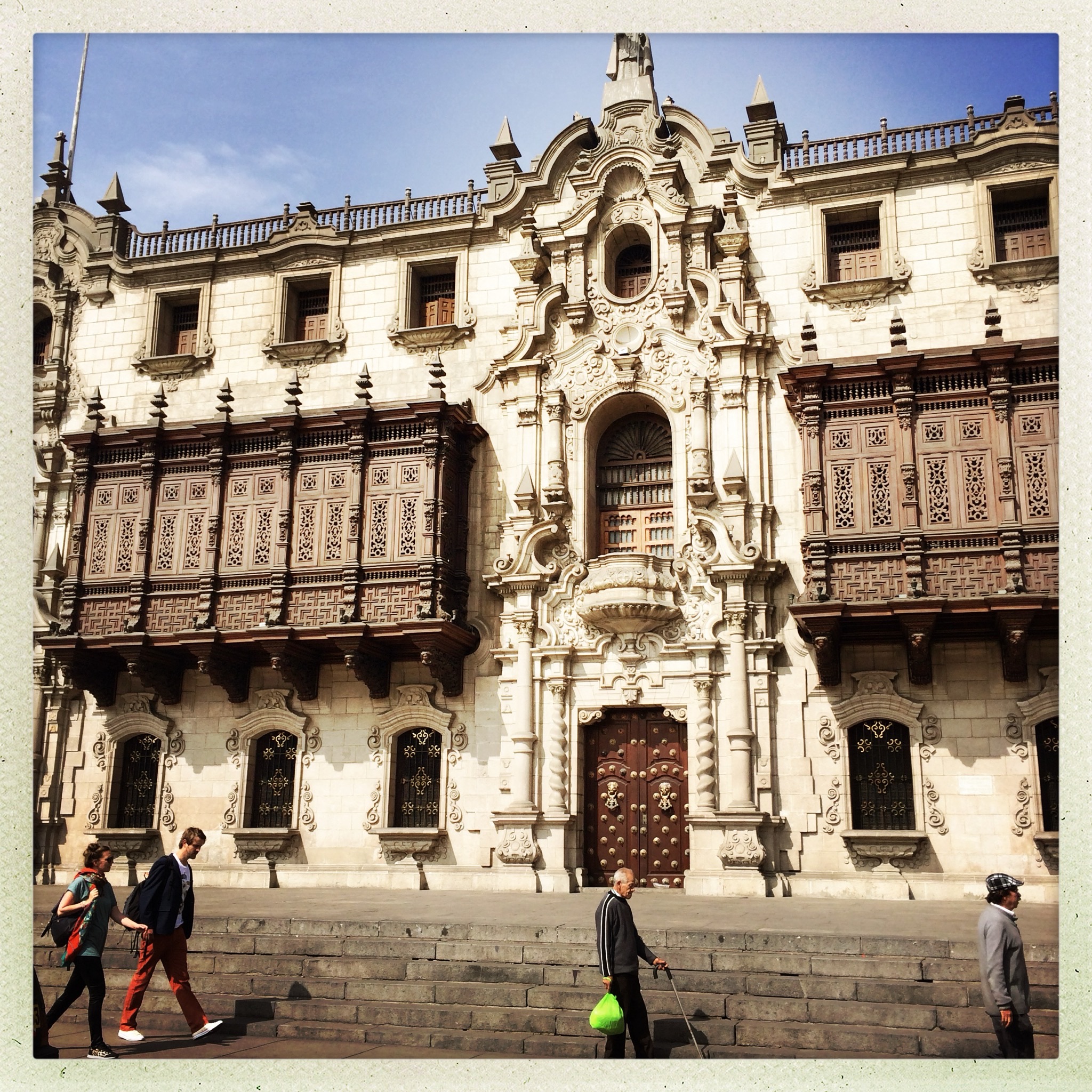
Around the Plaza de Armas de Lima, all the major government buildings are gathered, in impressive neo-classical colonial fusion style. Apparently this made the work of corruption easier back in the day, as officials did not have so far to walk to make their “arrangements”. I do not know where Peru is currently placed in the world corruption league tables, so how many of the people wandering the Plaza on this sunlit afternoon are officials out on underhanded business is anyone’s guess!
Some of these impressive edifices have dark wooden balconies on the front that face the Plaza. The balconies are not open though, but fronted with intricately carved wooden panels. Behind these is where the ladies of the upper echelons of society would sit, and peek out, to watch the men walking on the Plaza, all without compromising their modesty through being seen in public! I love functional architecture…
Times have changed though, since such gender-segregating religious decorum.
“The Catholic population is really falling,” says Luis, with an inscrutable expression that could be sadness or satisfaction, or something else entirely. “The Catholics are only 80% of the population now.”
From my European viewpoint, 80% still seems high, but Latin America has evidently been used to more religious conformity over the last centuries. The many recent scandals of the Catholic Church regarding child abuse, the wide gap between the living standards in general society and that of the clergy, along with the Catholic Church’s preferential fiscal status in Peru, has promoted this decline.
Luis explains that in the Andes many cultivate both local animistic beliefs, for example by making offerings to mountain spirits, before going in for Sunday Mass at church. And they seem to reconcile this dualism easily. I look forward to seeing and experiencing this up close in the heights: good material for a trainee InterFaith minister to take in.
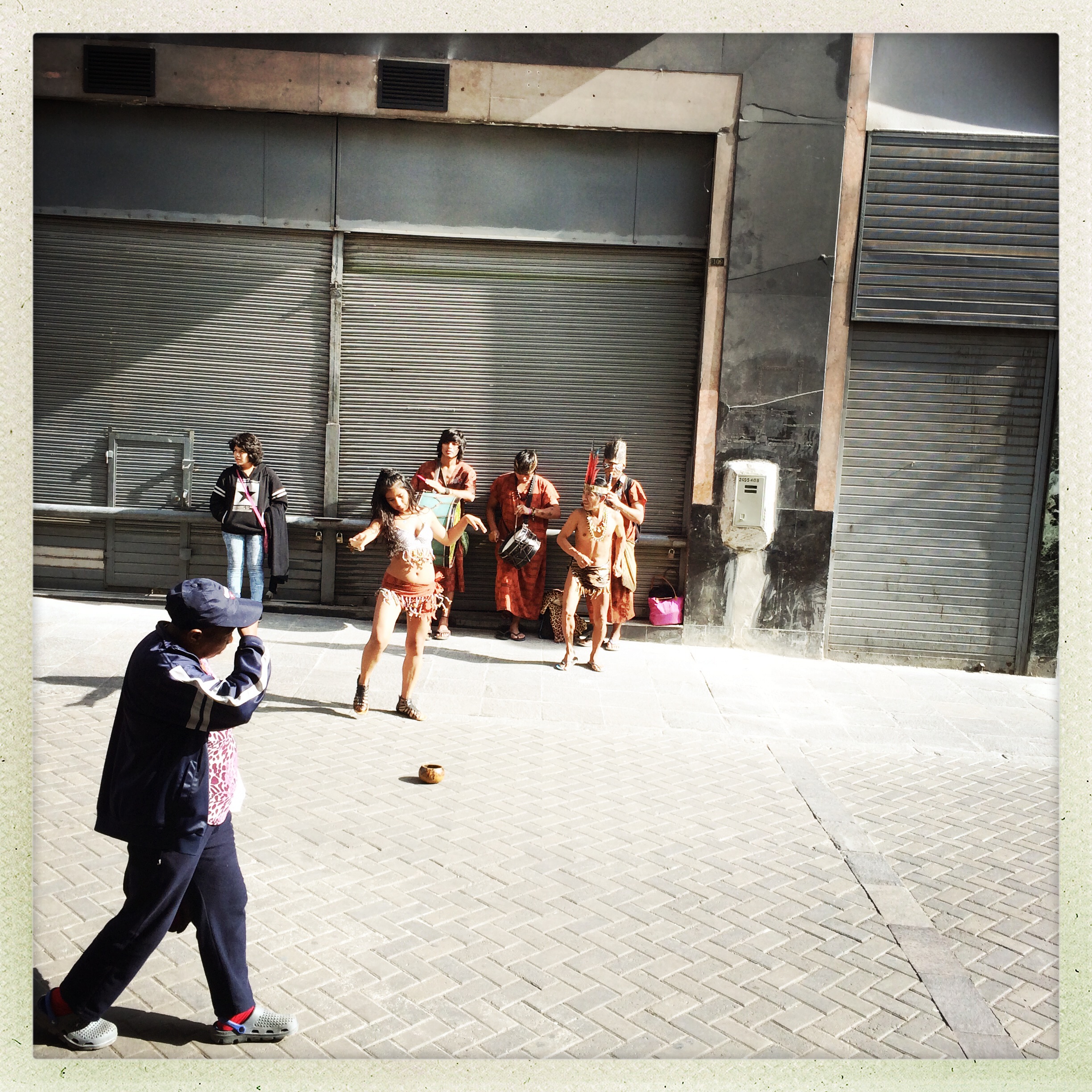
Finally, before we wave goodbye to Lima, it would be polite to address it by its proper name: Rímac. Lima is a Spanish mispronunciation of this Quechua word that means noisy river. The old Andean culture flows and mixes with the 21st century in its streets, as people from a native highland Indian tribe perform a dance to loud drumming on a side street. They are very scantily dressed, and hop around and gyrate in ways that remind me somewhat of samba. Behind them, a shop is selling Inca Kola.
We jump in a taxi to freight us back from the centre to the safe district of Miraflores where tourists can walk with less risk of mugging. The driver has the build and features of how I imagine an original Incan, with his flat round face, heavy brow, curly black hair and brown eyes. As he negotiates his way through the busy rush hour, he turns up a salsa song, and sings along while playing percussion on the steering wheel with his hands. One probably needs faith more than hands to drive in this wild and noisy river of traffic…
I am thankful to Rímac for shaking up my ideas without shaking the ground under me… this time. The next stop is the Amazon jungle, where flora and fauna await, and my being is filled with gratitude and curiosity at this Peruvian bounty.


