Benedicto is 73 years old and his eyes are shining in the candlelight under the brim of his Peruvian hat. He has been entertaining me with stories of growing vegetables, sailing wooden boats, and going to school for three years in his youth. We are sitting in the kitchen of his daughter, Flora, as she cooks us dinner over an open fire a few metres away. It is cold in this Peruvian evening time, but my heart feels very warm.
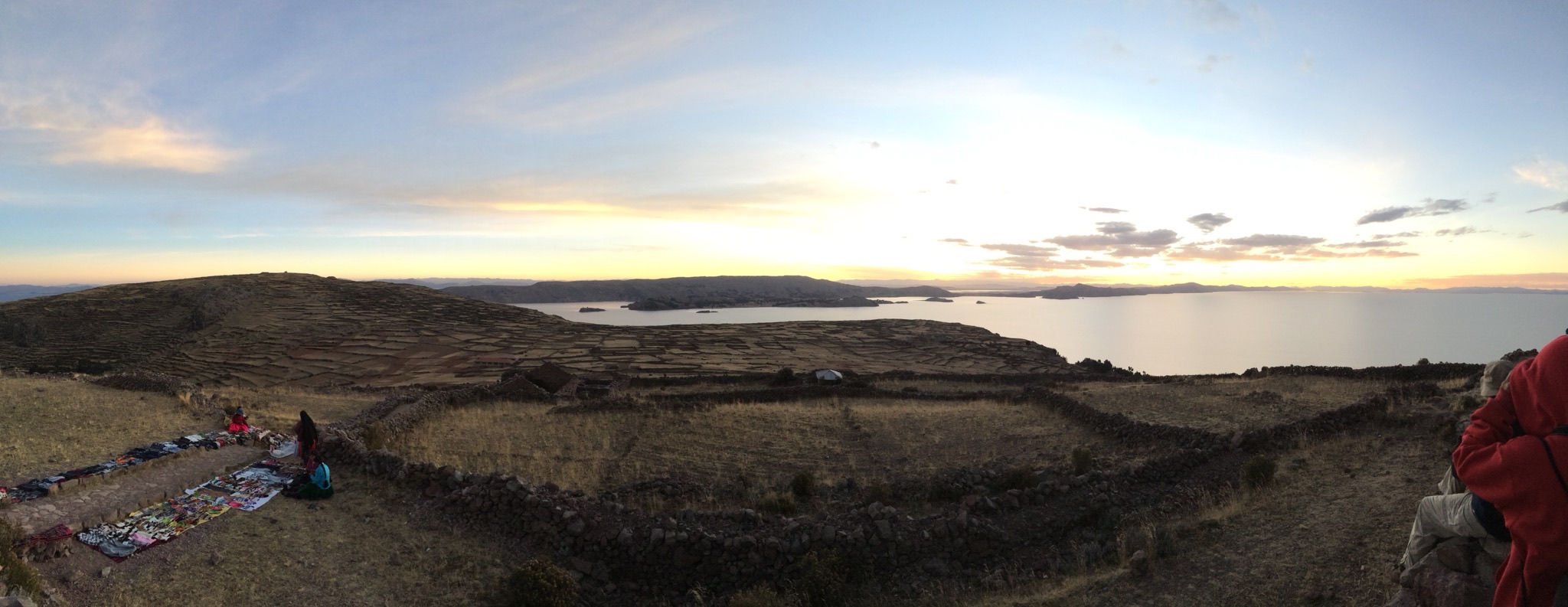
We are on the island of Amantani, which is the highest island in the world, at 3850 metres above sea level. Amantani sits in the lake of Titicaca, which claims to be the highest navigable lake in the world. It is certainly high, and the air is thin here. Going uphill is a slow and breath-taking proposition. Thankfully, we are sitting comfortably on the kitchen’s corner bench.
Benedicto speaks Quechua and Spanish, and he illustrates his stories of evading reefs in his boat with sticks and thin paper napkins on the table. Quite the actor, he also illustrates the waves crashing into his boat and making him wet from top to toe, just to make sure I get all the detail.
It is rare for him to have the chance to converse with someone from the outside world – meaning beyond the Peruvian shores of Titicaca Lake. He tells me that he has heard of somewhere called Holland where they have windmills, and that there is a single windmill on Amantani too. He does not use it though – this house has no electricity and everything is done by hand. The following day, he shows me how he grinds quinoa into the finest flour powder between two rocks. I am not nearly as good at it as he is when he lets me have a go… but then, he has had some practice!
Back in the candlelit kitchen evening, Flora has served dinner on the sturdy wooden table covered by a beautifully crafted red woollen cloth. She wove the table cloth herself. Potato soup, fried chicken, and homemade chips all await my tastebuds. This is all so far removed from the 21st century city life I lead that I occasionally get the impression I am in a medieval reenactment village. But no, this is very real — for Benedicto, for Flora, and for the 3000 other inhabitants on Amantani.
This is the last part of my Peruvian expedition, and through the homestay with Benedicto and Flora, I am getting a very real impression of life in the Altiplano – the high plateau of Peru – and Titicaca lake.

Europe feels very far away, and as I play translator for the few other international adventurers in Flora’s kitchen, it becomes clear to me that Benedicto and Flora do not really know where places like Denmark, Poland and Iceland are in the world. Benedicto says he has seen a couple of maps in his time, but he knows more about South America than Europe. And, of course, that makes perfect sense.
I would love to show Benedicto and Flora how far we have travelled to get to Peru. They cannot quite grasp that it is already past midnight in Europe… The scale of the world is a mysterious concept to them.
I remember that I have a World Atlas app on my iPad, which is currently stowed deep in my rucksack in the room upstairs, where I will be sleeping with at least three blankets over me tonight. It is both high and cold here on Amantani.
As the tasty stack of chips grows lower on my plate, I decide it is time to experiment with some very 21st century technology right here in the candlelight. Moments later, my iPad is in hand, and the National Geographic icon lights up on the screen as an interactive globe appears. Benedicto’s eyes glow even brighter as I turn the globe with my fingers, and zoom in on Peru, and then Lake Titicaca. “Aquí estamos” – here we are – I explain.
You can imagine his amazement as we play with this miraculous wonder, in a house where nothing is machine-driven. One of the neighbours has a radio, so Benedicto follows the World Cup in football, as all other Peruvians do with passion and fervour. He thus knows the names of countries like Spain, Portugal, France, Italy, and also Holland, of windmill fame. We find them all on the spinning globe together, and look at the names of their capitals. Flora also comes over and marvels at the size of the world, the iPad, and the warm-hearted, wondrous evening that is unfolding right in her kitchen. She is very happy.
The following day, Flora and Benedicto show off some their own wonderful skills and technology: we are shown how to fry grains over the fire and then squash them into coarse flour with a gigantic two-handed pestle and mortar made of local stone. Then it is time to practice the finer crushing with a flat stone against a slab, which I already mentioned that Benedicto was very adept at.
On our whirlwind tour of daily Amantani handiwork, Flora then sets up her loom, to weave a special colourful piece of cloth that her daughter would wear until marriage.
No sooner had she demonstrated this, with the dexterity that comes from years of muscle memory building, than we were off to learn how to plough a field! Instead of mules or cows on the yoke, it was two people, and a third to steer the plough behind them. I would not call our furrows exactly straight, but they were certainly well-intended and the best we could so at this huffing and puffing, oxygen-starved altitude.
I do not have any apps for this kind of learning on my iPad… This was the domain of open-hearted and open-minded exchange of knowledge and culture, from human to human.
Finally, we were invited to join in a small ceremony of thanks to Pachamama, Mother Earth, who is the main religion in these parts of Peru. We each selected three coca leaves from a generous pile, blew on them three times, and then deposited them on a colourful (handmade, of course) piece of cloth with llama decorations. Pachamama is revered, and not considered as a resource for human use. Part of whatever is taken is offered back with gratitude, and prayers for good health, plenty of work, and safe passage on travels in our case.
I felt honoured to translate this little ceremony for my fellow adventurers, and help hold sacred space for it, even covered in dust from the ploughing adventure… Who would have guessed that InterFaith ministry training would find a use on the island shores of Titicaca?
Come to think of it, that actually makes perfect sense. I travel, explore and connect in the name of the One Spirit. Here, they call it Pachamama.
On other islands closer to the city of Puno on Titicaca Lake, the Uros tribe make their home – quite literally. The Uros have been making their own floating islands out of reeds for many centuries, since pre-Incan times. Pachamama is also the overarching religion here, as I discovered when our hired ferry boat docked at the side of one of their reed islands on the way to Amantani.
About a fifth of these reed islands do not accept visitors, and prefer to be left in peace, which was their survival strategy when the small Uros tribe was threatened by other larger tribes around Titicaca lake. They simply built floating homes, and drifted off into oblivion. The Incas left them alone; the Spaniards wanted to use them as slaves but could not pin them down on the huge lake; and it was only around 45 years ago that the Peruvian government took notice of them again.
What the anthropologists and documentary-makers saw, when they set foot on these bouncy floating islands of reed, was a completely self-sufficient people who depended on reed and the lake for all aspects of life. Unfortunately their average life span was only 30 years long, due to the lacks in their nutrition.
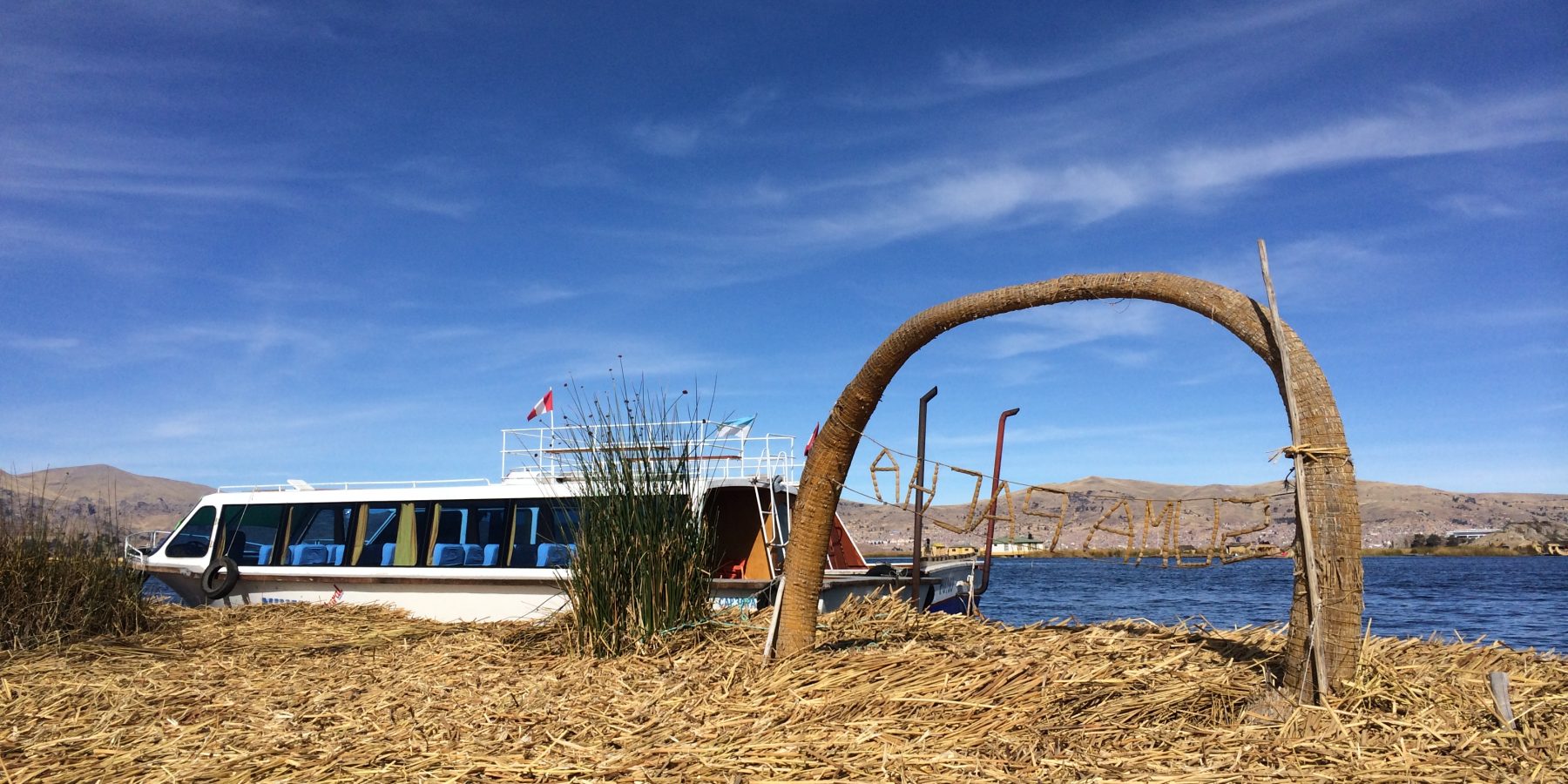
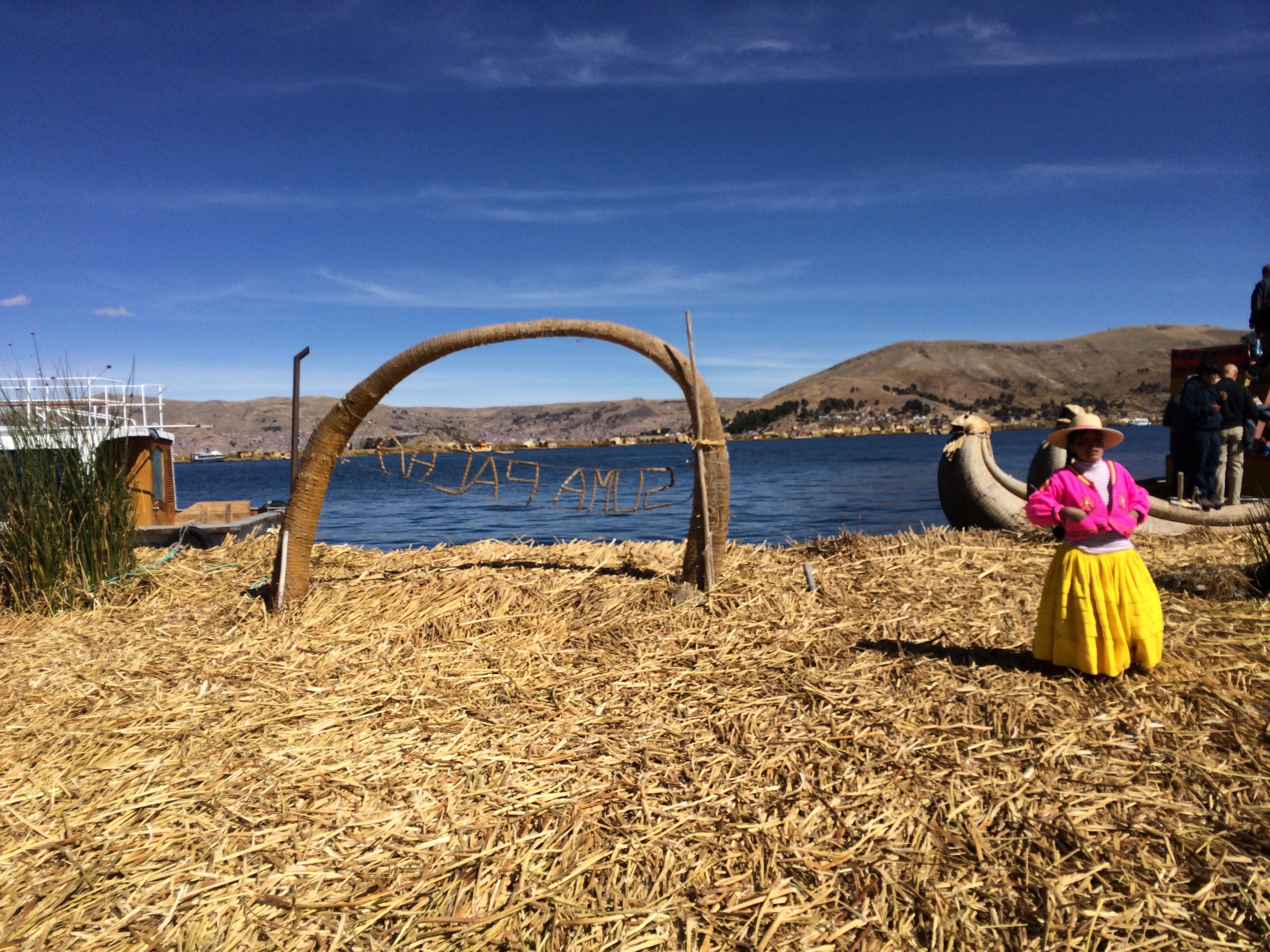
When we set foot on the reed island called Sumapacha, my group of adventurers was treated to a miniature demonstration of how the reed islands are made: through harvesting cubic metres of earth entangled with reed roots, which incidentally float like cork, tying these root cubes together, and letting them grow completely conjoined over the course of a year, and then piling a metre-high layer of cut reeds on top, horizontally, in a criss-cross pattern. On top of that lot, reed houses could be built, raised about half a metre off the reed floor to keep the humidity at bay.
It was, and is, essential for these islands to float, so that the changes in water level in Titicaca Lake do not damage the Uros tribes’ reed abodes. Every three years, the weather phenomenon known as La Niña can bring a three-metre rise in the water level, and every 200 years, the waters can rise over five metres!
The Uros islanders need to renew the reed covering on their floating islands every 14 days, and reed houses need rebuilding every six months. Their reed-based boats can last up to two years before the reed gives out. This is a life of constant renewal, intimately linked with the microcosm of Titicaca Lake, and its plants, fishes and birds.
Within the Uros tribe, men and women are completely equal. This is in homage of Pachamama, where all are equal on Mother Earth. The island we alighted on was currently under the presidency of a vertically diminutive but horizontally generous lady called Maria. Elections are held on a yearly basis, and all islanders over 18 can vote for their favourite candidate. Men look after children, clean reed houses and cook food just as much as the women row boats, go fishing, and… run the island!
My impression of the Uros islanders, including the children bouncing around, is one of happiness and also clever organisation. There is a floating medical clinic, a kindergarten, and even a bank complete with a cash machine. Some reed roof tops sport solar panels and satellite dishes. President Maria’s main hobbies are drinking beer and watching five different soap operas on her small television in her hut. Her lifespan, as well as those of the Uros people in general, has now increased to 65 years.
The Uros have their feet firmly planted in the 21st century, on these floating islands of theirs. What Benedicto on Amantani island would make of this, I am not quite sure…
However, the working principles these islands’ inhabitants have shared since pre-Incan times are ones of mutual assistance, which I have the feeling that we could benefit from in the 21st century too. These principles come in three degrees:
AYNI: This means “Today for you, tomorrow for me” and is used on a small scale between individuals, for example with house building assistance for newly married couples. The “you” before “me” is important: one lends help and then can ask for help later when needed.
MITA: This applies to communal works, like new stone-paved pathways, that a whole community decide that they need for their common good. Once the community makes the decision about what is needed, they all help to achieve it.
MINKA: This principle is no longer used in the Incan Territories, but it historically explains how certain enormous sacred sites were built: whole provinces would send help, like 20,000 people for Saqsaywaman; or after natural disasters, neighbouring provinces would send soldiers, builders and other assistance on a gigantic scale.
On Amantani island, I feel how I lived the Ayni principle for just a few hours, sharing knowledge and skills with Benedicto, Flora and the islanders. And I know from experience the social bonding and heart-warming feeling of accomplishment that the Mita principle can bring when a group of people decide to undertake a task for their community together. What the Minka principle could bring us all, in the 21st century, defies my imagination but fills me with awe…


