(in non-alphabetical order)
Fig trees: These trees grow buttress roots to not fall over when they reach a certain height, as their roots only otherwise penetrate the top layer of soil where the nutrition is concentrated…
Without deep roots, the trees would normally be blown over by the wind, so the pyramidal base structure they develop keeps them upright with only shallow roots.
There are hundreds of types of fig tree in the Amazon, ranging from bushes to medium size trees to 20-30 metre giants. They provide a food source for birds and monkeys up high, while tapirs and other land-based animals enjoy the fruits that have fallen to the ground.

Parapara: These leaves are cooked and made into an alcoholic drink, called Rompe Calezon (RC) which means “underwear-breaker” — it is essentially a natural Viagra!
Sanipanga: This sacred green plant is crushed by Amazon tribes (Indianas) between their palms and mixed with water, which generates a red pigment that turns purple as it dries. It is used to paint the faces of those who go onto the jungle to ward off evil spirits. I can testify that traces of the dye last for at least 3 days, even with rigorous washing.
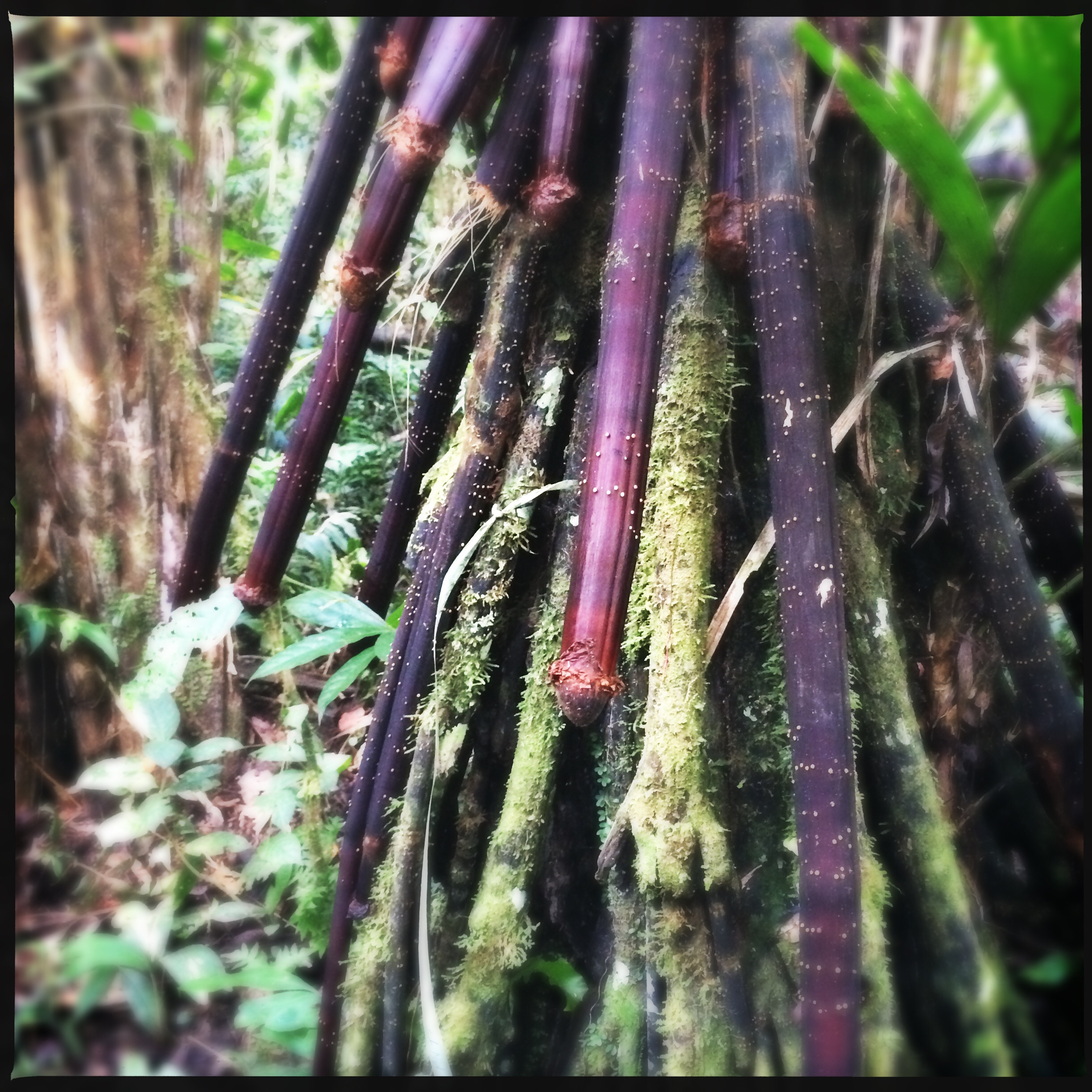
Cachapone: A walking palm tree that moves towards sunlight at rate of 10-15cm every year. It looks like it is on stilts, and grows new roots from one to two metres up its trunk on the side towards which it wants to “walk”. As the roots grow down to the soil and attach, they pull it that way, while the old roots on the other side help by pushing it forward. These walking palms may just be the inspiration for the Forest Ranger trees in The Lord of the Rings. The native people also call this tree an “erotic palm” due to shape of the new roots as they push diagonally downward: they are unmistakably phallic in shape. That part did not feature in the Hobbit tale…
Secropia: This tree hosts fire ants (tangarana in Quecho language) from when it is a sapling, and the ant colony destroys the leaves on neighbouring trees and ensures no animals climb it to eat its own leaves. This ensures the secropia gets as much sunlight as possible in the canopy competition. More sunshine = happy tree = more sap = better food for the ants! The fire ant queen dies with the whole colony when the tree dies, except the fire ant princess who survives and finds another secropia sapling to colonise. Bark from the secropia can be boiled up and used as an anti-diarrhoeal – if you can manage to scrape off some bark without getting bitten by its little bodyguards! Native tribes would tie prisoners of war to the secropia tree trunk as a type of torture, and with 10,000 or more fire ants per colony, the prisoner would likely not survive the amount of poison the ants would inject with their bites.
Garlic tree: This tree has bark that smells of garlic, and it is used as natural insect repellent. If you chew on it, it is a natural people repellent too!
Curare: Leaves from this tree can be boiled to make a poison that attacks the nervous system. When an animal is shot with an arrow that has been dipped in curare, and the animal tries to run to escape, this spreads the poison faster in its bloodstream. The meat should then be charred by fire before being eaten to destroy the curare poison that will have perfused the animal’s body. Curare is now used in a medicinal sense as an anaesthetic and analgesic.
Leaf-cutter ants: These insects come in a variety of sizes all suited to their particular task. The daily jungle work of the colony is to harvest leaves and carry them to their nest (they can carry up to 10x their own weight) to let them decompose and grow mushrooms out of them to eat. There are soldier ants, carrier ants, path-cleaner ants… and leaf quality assurance ants, which reject any incoming leaf pieces that do not meet their standards at the ant hill! These leaf rejects are scattered all around the entrance to the hill, while leaf-cutter ant “motorways” that look like blankets of moving green carpets crisscross the jungle floor.
Termites: If these insects were not working hard turning dead wood into mulch in the Amazon, a scientist calculated that there would be a 5 metre high covering of fallen wood on the forest floor within ONE year! Termites make nests high up on living trees, which might look like beehives to those of us who do not come from termite-friendly latitudes. The smaller and more edible termites apparently taste like wood, and can keep a jungle survivor alive – if you can get over the idea of crunching handfuls of ants between your teeth. Plunging both hands into a termite hill, letting them crawl up both your arms and then squashing and smearing them all over you also creates a natural mosquito repellent. And possibly a human repellent too.
Mosquitoes: @!$%##!!
(although also children of the universe…)
Yellow-bellied piranhas: From my observations at the edges of Sachavacayoc Lake, these enjoy salt crackers and swim extremely fast. The speed at which our food offerings to them on surface of the water disappeared was unbelievable. I am glad that it was not any part of my body in the water – but the local guide’s hand, as he filmed them up close!
What Frank filmed under the surface of Sachavacayoc Lake:
(NB: Watch BIG piranhas dart past at 0:17 and 0:24)
Annie: French ex-pat who arrived in the Tambopata area 10 years ago as a tourist on a tour, and fell in love with the place. She proceeded to learn Spanish and build up the Cayman Eco Lodge. It is a “travail d’amour” – a work of love – she says, as I chat with her en route between the lodge’s bar and kitchen. In France, she would have been retired already, she says, but she is a hard worker. She admits she is no architect, but the local labourers and her have done a solid job of building the guest lodges. She welcomes visitors from all over the world, as well as local students from Puerto Maldonado at discounted prices so they can learn about their own cultural legacy in the jungle, a place that Annie feels great love for.
As we leave the lodge and prepare to return to Puerto Maldonado by river boat, Annie wishes us a little piece of beauty every day that may fill our lives with happiness. She seems to have found her own way of becoming symbiotic with the Peruvian Amazon jungle, giving and receiving from it in equal measure, with great love.
[box type=”bio”]
Visit Annie and the Amazon Jungle:
www.cayman-lodge-amazonie.com[/box]


