
“Dusky titti monkey!” The local rainforest guide signals to the boat captain to slow down and turn the boat around.
I see tangled branches, brown river water and grey skies… but I hear the small screeches that must be coming from the monkeys. I strain my tired eyes – it is only 9.30am but we have been up for seven hours already. Yes, just work that out to discover what time we were roused to get on a boat in the middle of the night. More later on why anyone would do such a thing while supposedly on holiday!
There is a veritable cornucopia of wildlife in these parts of the Amazonian jungle. After the sun went down at around 5.30pm yesterday, we went on a nocturnal tour around the extended grounds of the Cayman Eco Lodge where we are staying. It took three hours by river boat to get here, after an internal flight to Puerto Maldonado and then a bus transfer to the boat’s mud-caked moorings. While wandering around in the dark jungle night, we were met by a cacophony of sound from the “locals”.
In short order, within about half an hour’s torch-lit stroll, we saw: a Hoffmann’s two-toed sloth, a tarantula, a jumping spider, a glow-worm, a bronze-reflecting moth, a miniature frog, a poisonous spiky caterpillar, a grasshopper with impressive antennae, and a stick insect so well camouflaged with fungus that I had convinced myself it was a branch even after examining it up close. There were also big bright red heliconia (bird of paradise) flowers, white mosses, enormous trees, and tall grasses. My botanical knowledge is sorely lacking, so colours and sizes are the best I can do for now while filling in the flora of this picture painting.
I went to bed exhilarated but exhausted, with an odd sense of outlandishness: there was no World Wide Web connection in the candle-lit lodge, but instead, a nesting tarantula within 10 metres of my lodge’s window. Welcome to the jungle.
After too few hour’s sleep, it was time to roll out from under the mosquito net and make our way down to the river boat. We were off for a bit of macaw clay-licking, and that particular curiosity only happens just after dawn, three hours up the river.
It was a moderate humid temperature as the captain pushed off from the river bank, but as soon as the boat started picking up speed down the middle of the river, it got colder and colder. There was something surreal about the whole scene: speeding down the middle of the Tambopata river, which is a tributary to the Amazon itself, with nothing but cloud-filtered moonlight to light the way in the dead of night.
I spent the following couple of hours in a state of semi-consciousness, initially wondering how the captain could possibly see anything on the river, but becoming too cold and tired to care – the despondency of physical exhaustion. The reality of the situation, in the Amazon, travelling down a river, surrounded by wilderness, was about as real as the snippets of dreams that I was dipping in and out of.
Finally, as light started to give colour to the jungle landscape, the captain steered the boat up on a river bank. We waded through mud up a slope, grateful for the rubber boots lent to us at the lodge, picked our way through some thickets, and then installed ourselves behind some spacious greenery on the bank opposite orange-shaded cliffs where the macaw clay-licking was to take place.
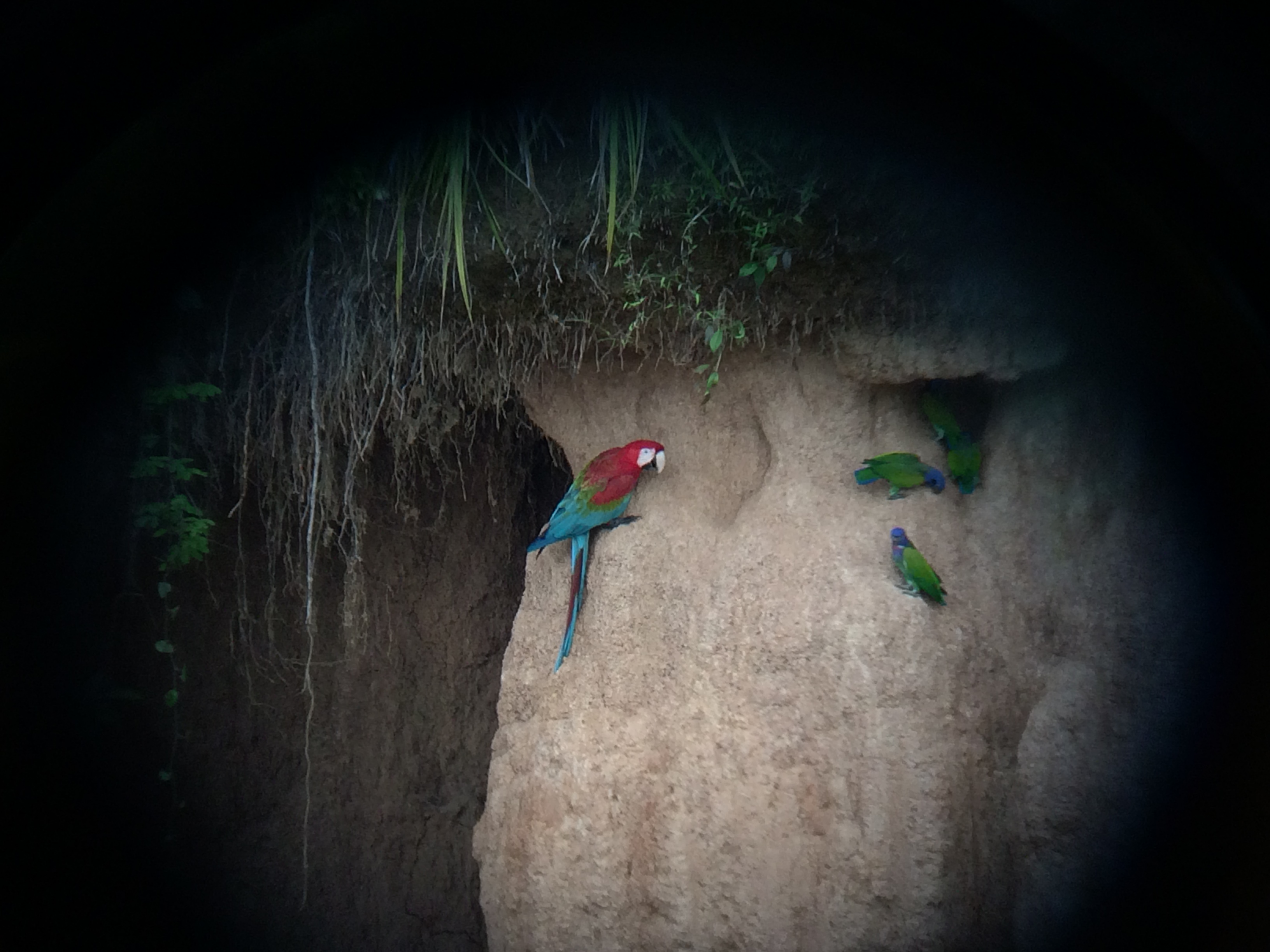
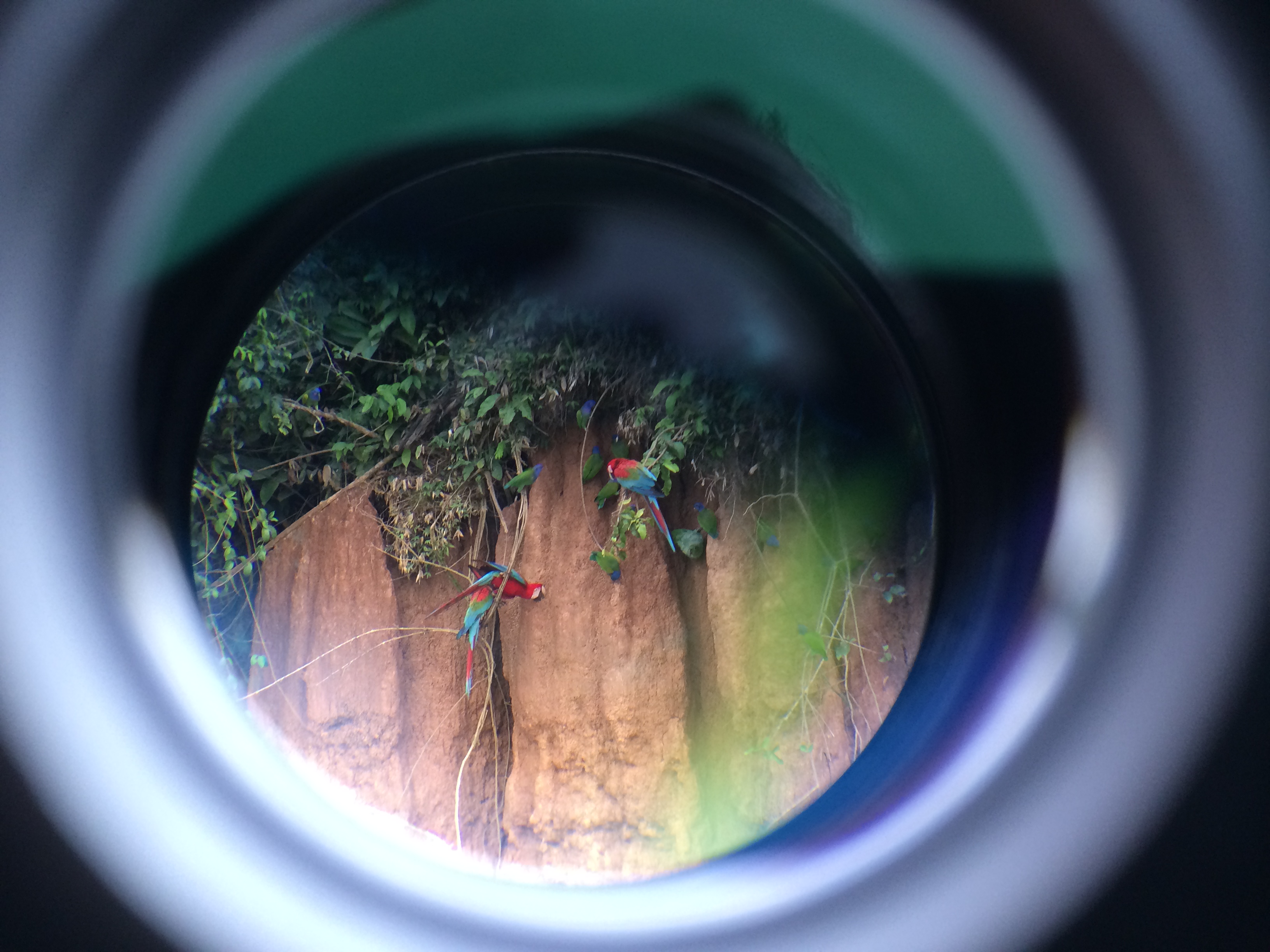
The timing was perfect: within moments, swarms of parrots with blue heads and green bodies started to appear in the trees above the cliffs. They hopped down gradually towards the more exposed surface of the cliffs, where predators would have much less of a challenge in making a juicy feathered breakfast out of one of them. And before long, they hopped and squawked and gathered onto the brown surface of the clay cliff… and started licking it!
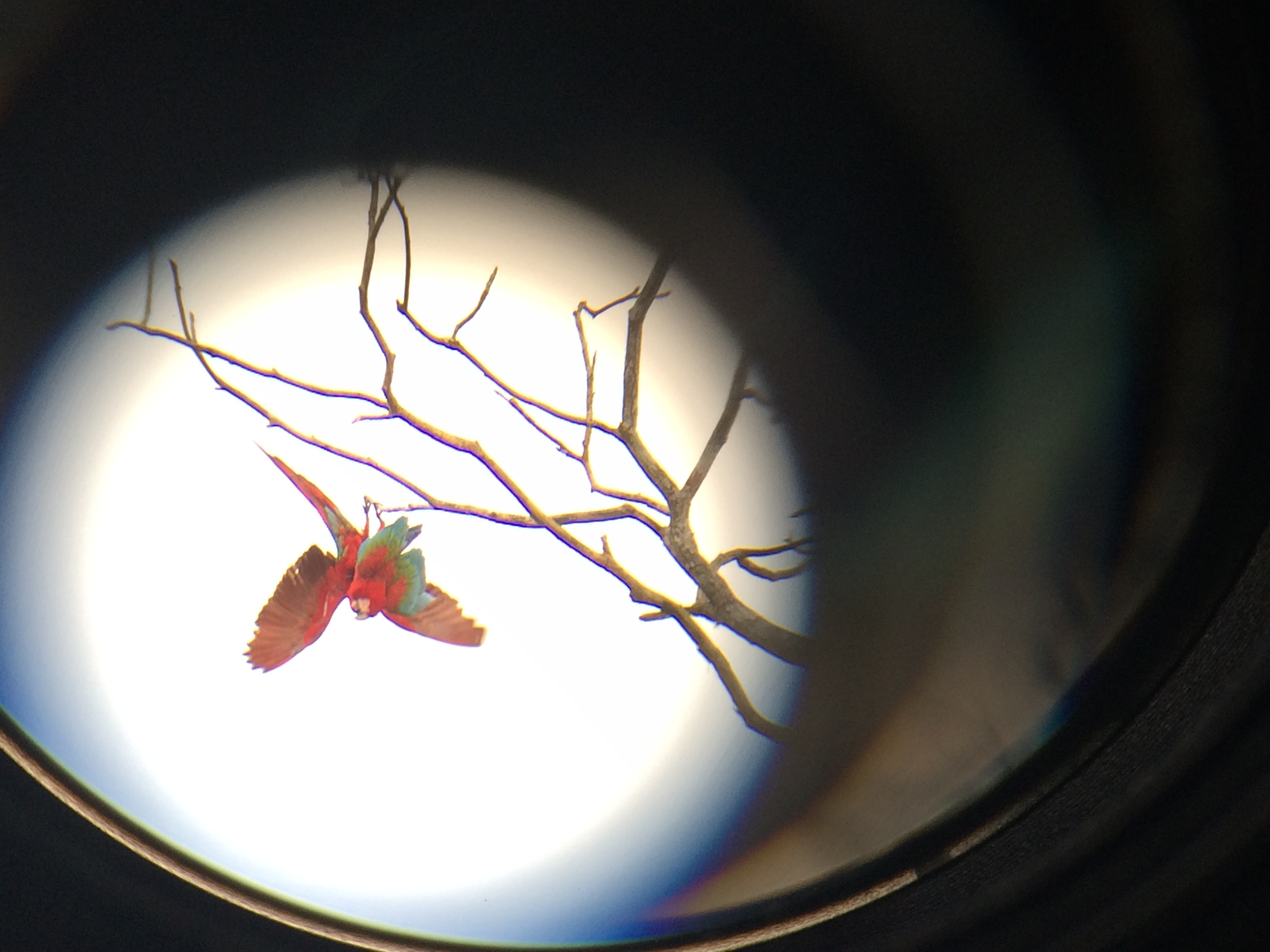
I learnt that parrots and macaws are different birds, on this Amazonian fauna crash course of mine, and quickly saw that with my own eyes too. Beautiful red, blue and yellow macaws, much larger than the parrots, with long tail feathers and a penchant for flying alone or in twos – or sometimes in threes if a couple had brought their baby along – started landing in the tallest trees above the cliffs. They do not lick the clay at the same time as the parrots because the macaw wingspan is so much larger, and they could risk breaking their wings on a cliff face full of dynamic parrots in clay-licking motion. So the majestic macaws await their turn on the cliffs, surveilling the situation from up high. Some of them started to preen themselves or swing upside down on the branches in more of a jesting than majestic way, and I loved them all the more!
We clicked our cameras through the guides’ high-powered telescopes as the “money shot” finally came: clay-licking macaws on the cliff faces!
Now, you may have been wondering just as I did: why on earth do the macaws lick the clay? The fruits that the macaws eat in the jungle contain certain toxins, and the calcium, salt and other minerals in the muddy cliffs counteract those toxins and thus help to balance the macaw diet. Apparently it is also a part of macaw socialising to hang out on the cliffs… A bit like a human bar, or perhaps vegan café at dawn!
On the way back to the lodge after this most unusual of spectacles – at least for someone who lives in South East London – we are encouraged to watch the riverbanks closely. Pumas and leopards are sometimes seen in these areas. That would be rather exciting… from the safety of the boat!
It does not take long before we come across several capybaras that are completely undaunted by humans wearing orange life vests in river boats, and they even pose for some photos while finding the best grass to chew on along the very edge of the banks. For those who are as unfamiliar with capybaras as I was less than 18 hours ago, they are the largest rodent in the world, and look like a mix between a hamster, a pig and an otter. They are about the size of a medium-sized Schnauzer dog, but with a much rounder and heavier body and shorter legs. In some places, not far from this river, the capybara is considered a very tasty meal and its fur and hide are used for clothes and shoes. In the nature reserve, the capybara may not have cottoned on to this yet, as it looks right back at us as we let our digital cameras loose on it.
Further down the river, we come across one cayman after another… like mini crocodiles, sunning themselves on the mud banks, but quick to slip in as soon as we get too close. This seems like a strange role reversal with the capybaras: the predators slip away from us, while the prey pose for photos! Maybe this is a whole new survival strategy under development…
It was not the day for pumas or leopards to pick up capybara posing habits today, but back at the trees where the guide had seen a monkey, all the way back at the beginning of this jungle tale — suddenly, among the branches of the trees, I see the dusky titti monkey!
Well, I see a small brown blob with a tail hanging down from a branch, which I can easily persuade myself is this delightfully named monkey. I am so overwhelmed by the hugeness of it all that spotting one monkey in one tree is almost a relief for my senses.
As the river boat now speeds us back towards the lodge and a long nap in the hammocks outside, a realisation comes to me.
While observing the mud-licking macaws, I had to go relieve a call of nature, and wandered a little way off down the riverbank. Suddenly I was on my own, away from the sound and sight of my group of intrepid travellers. I could almost convince myself I was there alone. The cracked drying mud of the riverbank, the squawking macaws, the humidity, and my senses coming sharply alive. What would I do if I were here alone? Would I be afraid? How would it change my relationship with the macaws? With the river? With myself?
Being in the safety and shared experience of a guided group somehow affects my experience of the landscapes. I attune to the energy of the group, and spread my attention around both those immediate human surroundings and the wider environment of nature. I feel like I should be focussing completely on the jungle and how it moves in me…
I realise I actually feel a bit annoyed! My other big travels have often been on my own, perhaps with a guide and porter for back-up, and my exposure to the environment has thereby been immersive and intensive. Right here, right now – and not with frequent reminders and talk of other times and places, like “back home”. The group has a buffer effect on the raw exposure that I delight in, hence my annoyance at this experience perhaps being less than it could be…
Much later, night has fallen and the skies are unbelievable. The starlit heavens are truly astronomical in scale, and, for the first time in my life, I can see some of the depth of the universe… Every star is clearly at its own distance from the planet I am observing them from, instead of the flatter appearance of the sky I am used to. I could be imagining things, but I even believe I can see the Milky Way’s cloudy light trail up there.
Suddenly I smile at myself. The stars are as much “in my way” of viewing the heavens as my travelling companions are of experiencing the world! They form part of it, and are in fact one and the same. Through their eyes, I see new perspectives, feel new connections to humanity. Through their shine, the world I so long to be exposed to is even more alive. It gives me the opportunity for more challenges, more musings, more laughter. My own emotions, also, are part of the world, like shooting stars through my own skies… My annoyance, my delight, my fear, my joy, and dusky titti monkeys. Shooting stars passing through Amazonian night skies — all part of the whole.
And now it is time to lay my head to rest, to the symphony of that great Oneness, streaming in through the netted openings that serve as windows in the lodge.
Squawks, c l i c k s, chirps, buzzzzing, CLACKS, chirrups, #whistles#, zzzZZsnoresZzzz…
and peace.


